Showing posts with label Brahms Johannes. Show all posts

Saturday, November 1, 2014


“The Armenian brother-and-sister team give passionate, deeply felt performances of all three sonatas...what gives these performances their particular strength is the performers' ability to project the crucial movements of harmony on which the sense and appeal of Brahms's music rests.” --Gramophone Magazine, Awards Issue 2013

“As one listens, it becomes clear that they have a strong grasp of each movement as a structure. Classicism may not be uppermost, but it certainly hasn't been sacrificed.” --BBC Music Magazine, November 2013 ****


Sergey Khachatryan’s fifth recording on Naïve, and second with his sister, is dedicated to the three luminous and deeply romantic sonatas for violin and piano by Johannes Brahms. Spread over ten years, from 1878 to 1888, the three sonatas are contemporary with his four symphonies and are flanked by the Violin Concerto in D major (1878) and the Double Concerto for violin and cello in A minor (1887).

A distinctive, gifted, often heart-rending violinist, Sergey Khachatryan has been establishing a brilliant career worldwide, in both recital and concerto fields. His recording of the Shostakovich concertos with the Orchestre National de France under Kurt Masur [v5025] was a Gramophone Choice.

Sergey's exclusive recital partner is his sister, pianist Lusine Khachatryan, which whom the musical connection has always been very special. Together, they regularly perform at the most prestigious venues in the world, such as London's Wigmore Hall, Théâtre des Champs-Elysées and Cité de la Musique (Paris), Auditori Nacional Madrid, Amsterdam Concertgebouw, Palais des Beaux Arts (Brussels), Carnegie Hall and Alice Tully Hall (New York) and Herbst Theater in San Francisco.

In early 2014, Sergey and Lusine Khachatryan will perform this Brahms programme at the Wigmore Hall and in other prestigious European venues.

Recorded in July & August 2012 at Wigmore Hall.

Sunday, October 5, 2014


One of the most sought-after trios in the world, the Eroica Trio thrills audiences with flawless technical virtuosity, irresistible enthusiasm and sensual elegance. Whether playing the great standards of the piano trio repertoire or daring contemporary works, the three young women who make up this celebrated ensemble electrify the concert stage with their passionate performances. 


Sunday, September 28, 2014

 
A member of the Berlin Philharmonic since 2002, Stefan Schulz is one of the world’s leading bass trombonists. This recital programme was recorded live at a concert in the Chamber Music Hall of the Berliner Philharmonie. The programme was chosen to emphasize the various facets of the bass trombone and in particular its ability to play music of a songful character. This certainly applies to Brahms’ Four Serious Songs, as well as the cantabile works by Lebedev and Šulek as well as Jan Sandström’s simple Song to Lotta, appearing as an encore. To balance the programme Schulz has included a work by Daniel Schnyder, the New York-based composer and saxophonist with whom he collaborates closely.


"All round this is an impressive disc. It is surely a must for anybody with an interest in the bass trombone. Improbable as it may seem, it would also be good if the disc could also find an audience outside of that tiny group. Whatever sort of instrument Stefan Schulz plays, his solo work deserves to be heard purely for its musical qualities. He is a major talent and I look forward to his next recital recording." (Gavin Dixon, Music Web International).

A member of the Berlin Philharmonic since 2002, Stefan Schulz is one of the world's leading bass trombonists. As implied by the title of this recording - his first solo disc -, it is a recital programme recorded live at a concert in the Chamber Music Hall of the Berliner Philharmonie in 2008. The programme has been chosen to emphasize the various facets of the bass trombone and in particular its ability to play music of a songful character. This certainly applies to Brahms' Four Serious Songs, as well as the cantabile works by Lebedev and Sulek which both seem to point to the sonorities of Romanticism; but it is equally true of Jan Sandström's wonderfully simple Song to Lotta, appearing as an encore. To balance the programme Schulz has included a work by Daniel Schnyder, the New York-based composer and saxophonist with whom he collaborates closely. subZERO, Schnyder's concerto for bass trombone, places great emphasis on virtuosity and reaches out in the direction of jazz. Here performed in the composer's own chamber version (for the first time available on disc), this virtuoso composition also provides variety in terms of sound as it includes marimba, percussion and violin as well as piano.

Sunday, September 21, 2014

“The Brahms Violin Concerto has been recorded so often that exceptional performances should not be as rare as they are. But this is one of them...Chailly calibrates an ideal balance. Kavakos's violin tone is super-refined and elegant.” --BBC Music Magazine, Christmas Issue 2013 *****

“This is indeed a splendid recording of the Concerto. The Gewandhaus Orchestra sound bright and resplendent in the great D major tuttis...with Chailly ensuring perfect balance. Leonidas Kavakos, too, alongside his customary ringing tone and clear, polished delivery, gives evident care and thought to the shaping of each phrase.” --Gramophone Magazine, December 2013


Leonidas Kavakos tackles a pillar of the violin repertoire in a disc that establishes him as a concerto soloist for Decca Classics

His first concerto disc for Decca features the Brahms Violin Concerto, for which he is joined by one of the world’s greatest orchestras and conductors, the Gewandhausorchester Leipzig and Riccardo Chailly.

Leonidas is also accompanied by pianist Péter Nagy for Brahms’ timeless Hungarian Dances (No.s 1, 2 ,6 and 11) and Bartók’s energetic Rhapsodies and Romanian Folk Dances – two great composers hugely influenced by Hungarian folk music

Richly charismatic music in superbly spirited performances by musicians who have this repertoire in their blood.

Tuesday, September 16, 2014


“This is the Brahms piano concerto set we’ve been waiting for. Nelson Freire and Riccardo Chailly offer interpretations that triumphantly fuse immediacy and insight, power and lyricism, and incandescent virtuosity that leaves few details unturned, yet always with the big picture in clear sight. ...these gorgeously engineered, stunningly executed and temperamentally generous performances will stand as points of reference for generations to come.” --Gramophone Magazine, September 2006

Gramophone Awards 2007 Record of the Year


“This is the Brahms piano concerto set we've been waiting for. Nelson Freire and Riccardo Chailly offer interpretations that triumphantly fuse immediacy and insight, power and lyricism, and incandescent virtuosity that leaves few details unturned, yet always with the big picture in clear sight. The D minor No 1's headlong opening tutti updates Szell/Cleveland's patented fire and brimstone with a warmth of tone that manages to convey both line and mass as few others do. Timpani and brass proudly step up to the fore in both concertos, while frequently buried lines emerge from the gnarly textures with uncommon clarity and specificity. In Chailly's hands, a genuine chamber music aesthetic consistently governs the lustrous warmth of Brahms's underrated orchestrations, to say nothing of the heights to which the conductor has led his revitalised Leipzig Gewandhaus ensemble.

Balanced within the orchestra as an equal partner, Freire is completely on top of and inside both works' solo parts, from No 1's fervent yet cogently shaped octave outbursts and the B flat's graceful, light-footed finale to both slow movements' unforced simplicity, organic flow, and freedom from sentimentality. No doubt that the presence of an audience fuels the palpable give and take between soloist and conductor. Just as the Szell/Cleveland cycles with Serkin and Fleisher, and Gilels/Jochum (reviewed below) were benchmarks in their day, these gorgeously engineered, stunningly executed and temperamentally generous performances will stand as points of reference for generations to come.” --Gramophone Classical Music Guide, 2010

Friday, August 8, 2014


“I want to hear more of Hardy Rittner, an exceptional talent...Dabringhaus und Grimm makes adventurous records. Here is one. If you're open to notions of 'historical' orchestral sound and to pianos in evolution when they were less standardised than today's, do try it.” --Gramophone Magazine, January 2012

“Ooh, controversial; beefy Brahms played on an 1854 Érard and accompanied on authentic instruments...the reduced strings aren’t an issue, although the Érard’s occasional hollowness of sound is mildly distracting.” --MusicWeb International, February 2012


The first Brahms piano concerto is a touchstone for every pianist but until now no-one has dared to record the work on historical instruments. Hardy Rittner is joined by the l’arte del mondo orchestra under Werner Ehrardt and the result of taking the risk of a live performance is a great recording.

Saturday, July 26, 2014


“…the young Swede Martin Fröst plays with elegant phrasing and beautiful, even produced tone… In the two sonatas, he's perfectly matched by his compatriot Roland Pöntinen in performances which capture Brahms's serious, autumnal mood without undue heaviness... cellist Torleif Thedéen proves as adept as his colleagues in producing singing tone and velvet pianissimos, and equally sympathetic to the ageing Brahms's elusive blend of resigned melancholy and abiding generosity of invention.” --BBC Music Magazine, February 2006 *****


“Young Swedish clarinettist Martin Fröst has established himself as a leading soloist, appearing with many of the most important European orchestras and inspiring works from composers including Penderecki. He tends to favour speeds on the fast side in the Trio, which means that the second movement Andante may lack the meditative depth one finds with Thea King on Hyperion but which has an easy flow. The dramatic bite and thrust of the outer movements is enhanced by relatively urgent speeds, with the coda of the first fading away on a ghostly scalic passage.” Gramophone Magazine, April 2006

“The Trio tends to be the neglected one among the great clarinet works from Brahms's mellow last period, usually coupled with the Clarinet Quintet as though a poor relation.

That is grossly unfair to a work which, while maybe not on such a grand scale as the Quintet, has over its four compact movements both profundity and charm. BIS, however, has put it with the sonatas, works on a scale closer to the Trio, and an excellent and successful coupling it is.

Young Swedish clarinettist Martin Fröst has established himself as a leading soloist, appearing with many of the most important European orchestras and inspiring works from composers including Penderecki. He tends to favour speeds on the fast side in the Trio, which means that the second movement Andante may lack the meditative depth one finds elsewhere but which has an easy flow. The dramatic bite and thrust of the outer movements is enhanced by relatively urgent speeds, with the coda of the first fading away on a ghostly scalic passage.

Cellist Torleif Thedéen matches Fröst in imaginative playing but pianist Roland Pöntinen, placed backward in the recording balance, is less individual. None the less this is a generously filled CDs and the couplings are apt.” --Gramophone Classical Music Guide, 2010

Friday, July 18, 2014


"The idea of choosing piano works for a solo recording that explores the concept of fantasy may not seem all that original. But on this fascinating album the Israeli pianist David Greilsammer explores the concept in a program of striking diversity, exposing musical resonances among disparate works by composers from Bach and Brahms to Cage to Ligeti. Of course the concept would mean little were the performances not so brilliant and probing. Mr. Greilsammer, born in Jerusalem in 1977, is a formidable pianist." --New York Times [11/9/2008]


“However it may look on paper, in practice it works incredibly well, such is Greilsammer’s magnetic ability to find mutual correspondences and attractions between opposite poles” --Julian Haylock, International Piano

“In this enjoyable piano montage, 16 items have been arranged symmetrically around Mozart’s Fantasy in C minor……it’s as though the alienation effect of piano “preparation” has been applied to a whole disc.” --Sunday Times Contemporary Composers (No. 3) Albums of the Year

“The pianism is superb” --Michael Church, The Independent

Thursday, July 17, 2014


“The expressive intensity of Mullova's playing goes hand-in-hand with an essential restraint.” --BBC Music Magazine, Proms 2007

Russian-born Viktoria Mullova is a violinist primarily known for her great virtuosity and a wide-ranging repertory that includes many crossover pieces. Mullova had a meteoric rise owing to spectacular wins at two major competitions: in 1980 she took first prize at the Jean Sibelius International Violin Competition and two years later won the Tchaikovsky International. The following year she defected to the United States, but would eventually settle in England.


Saturday, July 12, 2014


“The partnership of Julia Fischer and Yakov Kreizberg… really comes into its own in the symphonic proportions of Brahms's Violin Concerto. From Fischer's opening imposing entry, it's clear that Kreizberg and the Netherlands Philharmonic Orchestra are at one with her every nuance and tempo fluctuation - dramatic, fiery and impetuous at first but then beautifully lyrical and introverted in the second idea. ...the Double Concerto... Fischer and her partner Daniel Müller-Schott are absolutely on the same musical wavelength delivering a blisteringly intense performance supported by outstandingly responsive playing from the Netherlands Philharmonic.” --BBC Music Magazine, Proms 2007 *****


“Others offer tauter and brisker accounts of the first movement but Fischer amply justifies her spacious and flexible speeds in the feeling of spontaneity. Her performance never feels selfconscious or too studied and her range of tone and dynamic is extreme, bringing pianissimi of breathtaking delicacy. Fischer's slow movement, too, is expansive while in the finale she lets the tempo relax just enough to allow a persuasive spring in the rhythms, bringing out the Hungarian dance flavour.

The Double Concerto is not nearly as expansive: no doubt the influence of Müller-Schott was important here as the cello takes the lead in introducing each theme, with the cellist matching his partner in warmth and brilliance. Fischer and Müller-Schott are relaxed and easily lyrical in the slow movement, brilliant and thrusting in the finale. An outstanding disc which stands high on the list of this perfect coupling.” --The Gramophone Classical Music Guide 2010

Tuesday, June 24, 2014


The essence of a concerto is the contrast and combination of a solo instrument with a larger instrumental ensemble. Having developed out of the Baroque concept of concerto grosso, the concerto genre was fully established in the eighteenth century, and many works dating from this period are still a key part of the repertoire today. The opportunity for virtuosic display from the soloist has resulted in the concerto becoming a vital musical force on the concert platform.


The violin concerto owes a great deal of its development to the technical achievement of performers, and to this day many works are renowned for their fierce technical demands. Indeed, many composers who have written for the instrument were superlative players themselves—Wieniawski and Paganini among them. The fascinating history and capabilities of the instrument can be traced through the compositions contained herein; from the gossamer threads of Vivaldi to the exhilarating fireworks of Prokofiev, via the lilting swagger of Lalo and Saint-Saëns and nationalistic panache of Sibelius and Glazunov.

Sunday, May 11, 2014


One of the most charismatic and best-loved violinists of modern times, Germany's Anne-Sophie Mutter began her studies on the piano at the age of five. She shortly added violin lessons with Erna Hornigberger. In 1970 and again in 1974, she won first place in the Jugend Musiziert contest for young musicians. Herbert von Karajan heard her play at the age of 13 and paved the way for her international career. This began in 1977 with appearances at the Salzburg Festival and with her English debut under Daniel Barenboim. The next year, 1978, she made her debut with the Berlin Philharmonic and released her first recording, of the Mozart Third and Fifth Concertos.


Saturday, April 19, 2014


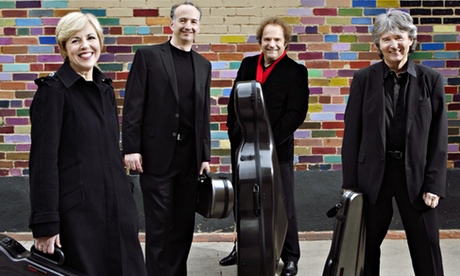
“These fine performances make a strong case for them.” Sunday Times, 6th April 2014

“Everything sounds as though it has been thought through extensively...The Takács's Brahms is like a superbly engineered road: we always know where we're going, and the views can be magnificent, but there are some interesting contours hidden beneath the tarmac.” BBC Music Magazine, May 2014 ****


"The repertoire for string quintet with second viola isn’t extensive, but small as it is, it’s still a treasure chest. What a shame, then, that it’s only the more adventurous quartets—the ones with close viola associates—that are prepared to take them on. Here are two works that ought to be valued alongside Brahms’s Piano and Clarinet Quintets. The Second String Quintet, particularly, is one of his most admirable and lovable large-scale works. But it’s also as challenging interpretatively as any of the Symphonies. So when this Quintet is performed or recorded, it’s rarely with the depth of understanding it needs.

Fortunately, the Takács Quartet and Lawrence Power show every indication of having given a lot of thought to both works. Everything sounds as though it has been thought through extensively. The fascinatingly fluid slow-movement-plus-scherzo that forms the centrepiece of the First Quintet is beautifully conceived. The impassioned, long opening paragraph of the Second is a magnificent balance of rich tonal weight and soaring momentum (perfectly caught by the recording); the Adagio is darkly eloquent and the finale’s rhythms are clean-cut and full of springing vitality. What we don’t get are the Romantic shadows and elf-lights, or the tender, sensitive Brahms half-hidden behind the bluff assertion. The Second Quintet’s Un poco allegretto—more ghostly waltz than scherzo or minuet—is finely wrought but lacking in subtler nuance. The Takács’s Brahms is like a superbly engineered road: we ahvays know where we’re going, and the views can be magnificent, but there are some interesting contours hidden beneath the tarmac." --BBC Music Magazine, May 2014 ****

Tuesday, December 24, 2013


"The box set Great Piano Concertos has been produced to celebrate the 25th anniversary of Naxos and draws on their extensive catalogue of concerto recordings. The recording quality varies from the older 1980’s recordings but there are some good things to enjoy in the 10 CD set particularly Idil Biret playing the two Chopin piano concerts with the Slovak State Philharmonic under Rubert Stankovsky. The two Liszt concertos with Eldar Nebolsin and the RLPO under Petrenko are also very enjoyable as is Jenő Jando playing the Grieg and Schumann concertos with the Budapest Symphony under András Ligeti. There are finer performances available in the catalogue of these works but this box set give an excellent introduction at a bargain price." --Audiophilia, May 2012


At the very heart of a concerto is the interplay and contrast of a solo instrument within a larger instrumental ensemble. The natural progression from the Baroque concerto grosso, the concerto as we know it was fully established as a concert staple in the eighteenth century, and many works dating from this period are still a key part of the repertoire today. The opportunity for dazzling virtuosic display from the soloist has resulted in the concerto becoming a vital musical force both on the concert platform and in the audience arena.

The most important composer in the development of the early piano concerto was Mozart, whose masterly compositions for the instrument paved the way for expansion of the form by composers such as Beethoven, Schumann, Brahms and Grieg. In the Romantic era, composers such as Rachmaninov and Tchaikovsky lent a distinctly Russian fluency and passion to the idiom, whilst no pianistic survey would be complete without the transcendent concertos of those great piano masters, Chopin and Liszt. The twentieth century transformed the piano concerto yet further with splendid offerings from a delicate Ravel, fiery Prokofiev and jazzy Gershwin to name but a few.
Subscribe to RSS Feed Follow me on Twitter!