Showing posts with label Handel George Frideric. Show all posts

Saturday, November 15, 2014


"It is no mean feat that Yate's delightful performance of these suites provides a rewarding listening experience without a dull moment despite a total duration of over 70 minutes." --BBC Music Magazine

"Edge of the seat playing that vibrantly dispels any thoughts of Handel's harpsichord music as dull." --Gramophone Magazine


Friday, November 14, 2014


"After three wonderful recordings by Niklas Eklund (Sept/Oct 1998:284), it is no surprise to hear more of the same here. Performing on baroque trumpet (valveless but with one or more tone holes for trills and intonation correction), Eklund shows exquisite taste, elegance of articulation, tonal purity, and virtuoso technique in these accounts of works by German composers. Each is given a reading full of nuance and attention to detail. This account of Telemann's familiar Concerto 2 has the best balance between trumpet, two oboes, and bassoon I have heard." --American Record Guide, August 2000


“Emma Kirkby… sings four solo cantatas… These showpieces make immense technical demands… But splendid though such displays are, it is her sense of characterisation which sets her apart. She can 'rejoice, laugh and hope' with palpable rapture (Un' alma innamorata, HWV173), change mood like quicksilver in the great Scena of Agrippina (HWV110) where the queen, condemned to death by her own son, swings schizophrenically from inconsolable despair to furious anger. Outstanding.” --BBC Music Magazine, September 2008 *****


“Emma Kirkby… is on superb form. Her interpretative intelligence and attention to words are a given but she can also catch a subtle mood, as in "Quel povero core" from Un' alman innamorata, whose sense of resigned torment is enhanced by a sensitive contribution from the solo violin.” --Gramophone Magazine, October 2008

“Emma Kirkby, a seasoned Handelian, brings her considerable artistry to bear on some of [Handel's] most bold, moving and exciting music. Occasionally, particularly in the tragic 'Agrippina condotta a morire', one yearns for slightly darker shades than her naturally sunny voice can provide. Even so, here and in 'Notte placida e cheta', 'Un’ alma innamorata' and 'Figlio d’alte speranze', she and the [musicians] of London Baroque relish to the full the dramatic genius destined shortly to take London by storm.” --Sunday Times, 24th August 2008 ***

Sunday, October 26, 2014


“This vivid act of reclamation has so much to teach, and to enjoy. It shows that Stokowski's arrangements were made not only with love but acuity; that their flair and poetry may survive beyond his own performances, given the flair and commitment displayed by the Brussels Philharmonic” --Gramophone Magazine, July 2011

“What’s a period-instrument specialist doing conducting the notoriously inauthentic orchestral arrangements of Stokowski? Having fun, that’s what. Baroque wonders by Bach, Handel and Purcell become dressed in showmanship...The Brussels Philharmonic plays persuasively for Egarr, and the programme’s terrific” --The Times, 8th January 2011


The charm and sheer full-blooded pleasure offered by Leopold Stokowski’s transcriptions continues to hold sway today – complete with opulent and resonant strings – some three decades after the dynamic conductor’s death. The “Stokowski Sound” was particularly, indeed deliberately, well-suited to the possibilities offered with the development of stereo recording of the maestro’s day, a challenge which Glossa’s engineer Manuel Mohino has happily embraced as much as the Brussels Philharmonic, whose members have taken to the style like ducks to water in this modern-day “Evening with Leopold Stokowski”.

Leading the way with a classy swagger in transcriptions of Bach, Purcell and Palestrina is a conductor in Richard Egarr, perhaps better known for his work with the unadorned originals (he is the Music Director of the Academy of Ancient Music, after all), but in reality equally at home in much later music – and he makes no bones about his appreciation of the Stokowski style. About the transcription of Dido’s Lament Egarr says, “It is still Purcell, even in Stokowski's fur coat.” and, for added emphasis, he conjures up his own orchestral confection of Handel’s Water Music. An evening’s entertainment of unalloyed pleasure culminating in a triumphant rendition of the Slavonic March by Tchaikovsky, à la Stokowski, naturally.

Commercial release sheet (PDF)

Thursday, October 23, 2014


This is a fine Handel compilation that provides a nice overview of his orchestral music with brass instruments, as well as his only incidental score (music written to accompany the action of a play). Christopher Hogwood uses the arrangement that Handel made of the Fireworks Music for normal-sized forces, including strings, which were absent from the original. All the music is played with a fine sense of style, and a goodly bit of the "pomp and circumstance" that Handel above all others knew how to capture in music. At two discs for the price of one, this is an extremely good deal. --David Hurwitz


Already in its LP for this Fireworks Music was one of the best performances available (certainly the best of the period-instrument versions), and on Compact Disc it makes a vivid impact. Steering a middle course between the vast instrumental armies which seek to re-create the original open-air atmosphere of the 1749 celebrations (with the horns baying across London's Green Park) and decorous concert-hall approaches, Hogwood secures grandeur without grandiosity, and there is plenty of excitement in the more jubilant movements. RF, reviewing the LP, would have liked more horns, but I didn't personally feel any lack in this regard: I do agree with him, however, that the properly exuberant drums do tend to screen out the bass line in La rejouissance. The F major Suite from the Water Music, here ending not in that unsatisfactory way with the D minor Allegro but with the Hornpipe better known in its later D major variant, is played in a brisk and lively, perhaps rather less committed fashion: the baroque oboes add a distinctive colour, as do the natural horns, whose intonation, if not entirely impeccable, is probably better than that of their predecessors on the Thames barge.

-- Lionel Salter, Gramophone [3/1983] Reviewing L'Oiseau-Lyre 400 059

Friday, August 22, 2014


Born in the former Yugoslavia, Marijana Mijanovi´c brings a genuine contralto tone to her choices, which she delivers with a flexible voice and a good articulation of text. She has plenty of vocal personality of her own, though she’s less good at defining the character and situation specific to each piece. But the skill is there to negotiate the Handelian line and the vivid coloratura her predecessor evoked in such works as Rodelinda, Radamisto, Giulio Cesare, Siroe and Orlando, even if she’s inclined to chug her way through the runs rather than making them sound easy. 


Sergio Ciomei and the Basel Chamber Orchestra provide sprightly support, adding in a handful of orchestral items from the same scores. A warm acoustic reflects a wide range of sound though there’s too much resonance. George Hall, BBC Music Magazine

Thursday, July 24, 2014


Music composed, arranged and transcribed by Charles and William Babell

Since it foundation in 1986, Trio Basiliensis has performed in many countries and has recorded numerous works for broadcasting companies in Europe and beyond. The succes of their concerts and CD recordings is borne out by excellent reviews that praise their lively playing, the stylistic soundness of their interpretationes and the technical brilliance of the three musicians.


Sunday, July 13, 2014

“D'Arcangelo articulates rapid-fire coloratura efficiently throughout…” --BBC Music Magazine, December 2009

This is the solo debut of one of the most exciting bass-baritones of today. Expertly advised by Baroque expert, Francesco Lora, D'Arcangelo fashions his debut album into a panoramic sweep of Italian Handel arias for bass-baritone. Mixing well-known and rare, lyric with highly virtuosic, D'Arcangelo's phenomenal Handel shows the versatility and wide range of Handel’s compositions for bass-baritone and the vocal capacity of the singer to master this programme. Undeniably appealing to all voice and Baroque music lovers, this album will excite music lovers well beyond.


"Brando" has enough of his namesake's smouldering good looks to make his mark with this debut solo anthology of Handel arias. Set to the period arrangements of Modo Antiquo, it's imposing stuff, with arias from Agrippina, Orlando and Rodelinda, a pair from Ariodante switching between wretched grief and exultant joy, and elsewhere a selection of hissing snakes, evil, darkness and terror, all wielded with an elegant grace occasionally bordering on the humorously knowing.
--Record Review / Andy Gill, Independent (London) / 25. September 2009

 This disc by an excellent bass-baritone is welcome, as it shows the fine music that Handel wrote for the male voice, broadening our appreciation of the extent and range of his operatic achievement . . . The singer has both sensitivity and technique, conveying the anguish of the lamentations while also realising the coloratura demands of the music without difficulty. Sensitive accompaniment from period ensemble Modo Antiquo. --Record Review / Colman Morrissey, Irish Times / 08. January 2010

Saturday, May 10, 2014

Handel arrived in Hamburg in 1703, aged eighteen. He spent four years in the city and wrote several works for the town's opera house. Hamburg opera was a rather eclectic beast at the time, drawing on Italian and French language and instrumental style alongside the native German. Handel fell happily into this genre; this CD brings together a selection of the delightful orchestral music (which tends to be in the French style) that Handel wrote there, some of it recorded for the first time.

'A highly entertaining collection. Delightful rarities from the young Handel' --Classic CD

'The disc is warmly commended' --Fanfare, USA

Sunday, March 2, 2014


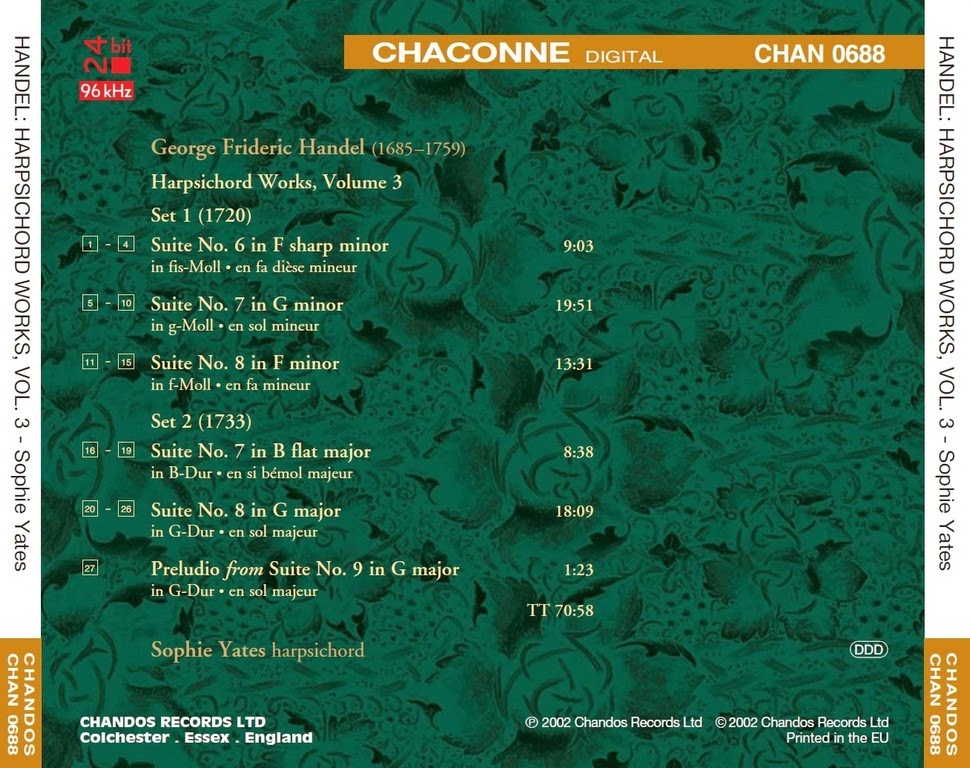
‘Sophie Yates confirms her credentials as one of Britain’s most talented harpsichordists …Yates has a neat, agile technique, phrases thoughtfully, with a restrained but telling use of rubato and ornamentation, and brings plenty of zest to the gigues and courantes. A disc to whet the appetite for further volumes in the series.’ --The Daily Telegraph on CHAN 0644 (Handel Harpsichord Works Vol. 1)

‘Yates plays her well-chosen selection with great subtlety and sparkle.’ --Gramophone on CHAN 0659 (Rameau)


Wednesday, February 12, 2014


One of the world's preeminent harpsichordists, Sophie Yates is known for her critically acclaimed performances of Baroque music... In 1999, Yates released her first album devoted to Handel's harpsichord music. In the liner notes for her second Handel album, Yates remarked that Handel's harpsichord pieces not only exhibit such typicially Handelian features as rhythmic vitality and melodic inventiveness, but also "give us a fascinating insight into the composer's more private world." 


Friday, January 10, 2014


Baroque music describes the period in Western classical music dating from approximately 1600 to 1750. The Baroque period saw the development of functional tonality, as well as new instrumental playing techniques and musical notation. It was during this time that opera was established as a musical genre, and the period also saw the expansion of the range and complexity of instrumental performance.


This collection concentrates on the instrumental music of the period. No survey of the Baroque would be complete without the music of JS Bach, whose Brandenburg concertos are commonly regarded as the apex of Baroque music. The radiant concertos of Vivaldi demonstrate the exhilarating range of instrumental colour that flourished at this time and contrast with the orchestral zest of Handel’s robust Water Music. From classical favourites such Pachelbel’s Canon and Albinoni’s Adagio, to Concerti Grossi from composers as diverse as Corelli, Handel, Locatelli and Geminiani, this set is the perfect compilation of works from this most fascinating of eras.
Subscribe to RSS Feed Follow me on Twitter!