Showing posts with label Tchaikovsky Pyotr. Show all posts

Wednesday, October 29, 2014

“A generous Tchaikovsky spectacular in masterly hands” --BBC Music Magazine, October 2009

“Like the very best music directors, you can’t pigeon-hole Antonio Pappano. He may have made his name with Puccini but he’s got an instinctive feel for structure and for style that makes him good at most things. His Tchaikovsky doesn’t disappoint, full of vigour, of tunefulness” --Gramophone Magazine

Gramophone Magazine Editor's Choice - February 2007
BBC Radio3 Building a Library First Choice - May 2010


“With chorus added in the 1812 as well as the Waltz from Eugene Onegin, this is an exceptional Tchaikovsky collection, a fine start for Antonio Pappano's recordings with his Italian orchestra.

What is very striking is how refreshing the 1812 is when played with such incisiveness and care for detail, with textures clearly defined. It starts with the chorus singing the opening hymn, expanding thrillingly from an extreme pianissimo to a full-throated fortissimo.

A women's chorus then comes in very effectively, twice over, for one of the folk-themes, and at the end the full chorus sings the Tsar's Hymn amid the usual percussion and bells, though Pappano avoids extraneous effects, leaving everything in the hands of the orchestral instruments. It is equally refreshing to have the Waltz from Eugene Onegin in the full vocal version from the opera, again wonderfully pointed, as is the Polonaise which follows.

What comes out in all the items is the way that Pappano, in his control of flexible rubato, is just as persuasive here as he is in Puccini, demonstrating what links there are between these two supreme melodists. So he builds the big melodies into richly emotional climaxes without any hint of vulgarity, strikingly so in both Francesca da Rimini and Romeo and Juliet. Pappano is impressive in bringing out the fantasy element in Francesca, and in Romeo the high dynamic contrasts add to the impact of the performance. There have been many Tchaikovsky collections like this, but with well balanced sound, outstandingly rich and ripe in the brass section, this is among the finest.” --Gramophone Classical Music Guide, 2010

Sunday, October 26, 2014


“This vivid act of reclamation has so much to teach, and to enjoy. It shows that Stokowski's arrangements were made not only with love but acuity; that their flair and poetry may survive beyond his own performances, given the flair and commitment displayed by the Brussels Philharmonic” --Gramophone Magazine, July 2011

“What’s a period-instrument specialist doing conducting the notoriously inauthentic orchestral arrangements of Stokowski? Having fun, that’s what. Baroque wonders by Bach, Handel and Purcell become dressed in showmanship...The Brussels Philharmonic plays persuasively for Egarr, and the programme’s terrific” --The Times, 8th January 2011


The charm and sheer full-blooded pleasure offered by Leopold Stokowski’s transcriptions continues to hold sway today – complete with opulent and resonant strings – some three decades after the dynamic conductor’s death. The “Stokowski Sound” was particularly, indeed deliberately, well-suited to the possibilities offered with the development of stereo recording of the maestro’s day, a challenge which Glossa’s engineer Manuel Mohino has happily embraced as much as the Brussels Philharmonic, whose members have taken to the style like ducks to water in this modern-day “Evening with Leopold Stokowski”.

Leading the way with a classy swagger in transcriptions of Bach, Purcell and Palestrina is a conductor in Richard Egarr, perhaps better known for his work with the unadorned originals (he is the Music Director of the Academy of Ancient Music, after all), but in reality equally at home in much later music – and he makes no bones about his appreciation of the Stokowski style. About the transcription of Dido’s Lament Egarr says, “It is still Purcell, even in Stokowski's fur coat.” and, for added emphasis, he conjures up his own orchestral confection of Handel’s Water Music. An evening’s entertainment of unalloyed pleasure culminating in a triumphant rendition of the Slavonic March by Tchaikovsky, à la Stokowski, naturally.

Commercial release sheet (PDF)

Sunday, August 31, 2014


“The pianist, Vincent Coq, is both brilliant and sensitive, taking great trouble over balance with the strings while dazzling the ear with his lightly scintillating virtuosity in the more sparkling variation movements.” --Gramophone Magazine, February 2014

“The Trio Wanderer has already given us the most powerful recording of the Shostakovich Second Trio that i’ve ever heard. Now, about a decade later, it provides accounts of the other two great Russian Piano Trios, with equally distinguished results ... a first-rate recording.” --International Record Review, February 2014


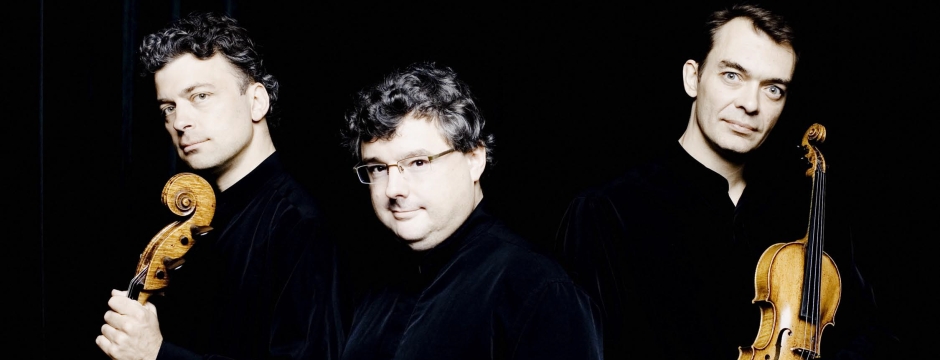
Tchaikovsky’s celebrated large-scale Trio Op.50 sets the tone of this recording, at once elegiac and virtuosic. Dedicated to his friend Nikolay Rubinstein with the French epigraph ‘À la mémoire d'un grand artiste’, it shows great originality both in its dimensions and in its style, which calls for highly skilled performers. A similarly ambitious work is the Trio Op.32 of Anton Stepanovich Arensky, also dedicated to the memory of a musician, the cellist Karl Davidov (1838-89). This gem of chamber music, much less often played, constitutes the true discovery of the programme. 


The Trio Wanderer celebrated its 25th anniversary in 2012. Feted by the international press for its extraordinarily sensitive playing, its almost telepathic complicity, and its complete instrumental mastery, the Trio Wanderer is one of the finest chamber music formations in the world today. Dubbed ‘Wandering Star’ by The Strad magazine, it is invited to appear in the most prestigious concert series and at the leading festivals. Since 1999 the trio have recorded for harmonia mundi: 13 recordings have appeared so far, repeatedly winning awards from the critics (Choc de l’Année in Le Monde de la Musique, Critics’ Choice in Gramophone, CD des Monats in Fono Forum, CD of the Month in BBC Music Magazine, Diapason d’Or de l’Année, Midem Classical Award). The group’s recent interpretation of the Mendelssohn trios was chosen as the benchmark version by the New York Times.

Saturday, August 16, 2014

“[Trifonov] makes the instrument sing and allows the music to breathe … The six Liszt song transcriptions show him at his best, triumphantly capturing all the despair of ‘Erlkonig’ … A pianist, then, with a great international career in front of him (no doubt about that).” --Gramophone Magazine, November 2012

“His special blend of attributes is on display here, not least his technical ease, exquisite control and rich resource of colour. In the Tchaikovsky [Concerto], Trifonov's playing ignites when it has to, but is generally notable for its dynamic phrasing and variety of articulation. For such an overworked piece it sounds remarkably fresh.” --BBC Music Magazine, December 2012 ****


“Trifonov's combination of delicacy and fire leaves an indelible impression in this debut recording with the Mariinsky. The Tchaikovsky, scorching and heart-rending but never bombastic, is paired with solo Liszt transcriptions” --The Observer, 12th August 2012

“Trifonov has won every top piano competition, and this shows why. His performance of the Tchaikovsky warhorse...is nuanced but not mannered, virtuosic without being showy, and powerful yet not hammered, as many young Russian pianists do...He has the world at his feet.” --The Times, 11th August 2012 ****

“Last year’s winner [International Tchaikovsky Competition] 21-year old Daniil Trifonov is truly exceptional. Trifonov … the orchestral support is first-rate … Even more impressive are the solo works included here which display all the variety of Trifonov’s tonal range … Seemingly there is nothing that Trifonov cannot do. Trifonov may be at the start of his career but he is already a mature artist. His youth brings an overwhelming energy which seems to blow the cobwebs off everything he performs: he forces one to listen to these works anew, the sure sign of greatness.” --International Record Review, October 2012

Friday, July 18, 2014


“On this evidence, Mikhail Pletnev remains one of the most intelligent and stylish Tchaikovsky conductors around...[he] possesses the happy knack of making one appreciate just how much extraordinarily novel and daringly spare much of the scoring is...The Scherzo in particular ignites, the tempo challengingly swift yet without any suggestion of breathless fluster.” Gramophone Magazine, January 2012 (on Pentatone new complete Tchaikovsky Symphony cycle.)


Sunday, July 6, 2014


"On this evidence, Lang Lang is already superbly accomplished. Especially in the first movement, however, the performance leaves an impression of individual moments intensely lived . . ." --International Record Review, September 2003

"No quarrels over his technical mastery: He's got accurate fingers (no smudges here), exceptional dynamic and timbral control (listen to the magical return of the A section in the second movement), and sufficient power for the climaxes . . . This performance has plenty of personality in its handling of details." --Fanfare, January 2004


 "Piano power . . . Chinese pianist Lang Lang's debut disc on Deutsche Grammophon will excite, astound and enthral . . . The orchestra is sensitive to every one of Lang Lang's tempos and rubatos, supporting him so that each virtuosic intricacy of the piano part shines through . . .The piano playing is mature, deeply felt, with a sense of bravado and almost nonchalant abandon. Lang Lang's wonderfully sensitive touch in the beautifully gently second movement dazzles us, before he produces even more incredible pyrotechnics in the frenetic, cheeky scherzo. The final movement is pure Russian dance and Tchaikovskian optimism -- the piano is uniformly characterful and crisp. Lang Lang has such total command of his instrument and its possibilities that it seems like the work of someone well beyond his 21 years . . . We say . . . Lang Lang is fast becoming a celebrity in the piano world. His debut with DG is full of panache and brilliance . . . Astounding." --Classic FM, September 2003

". . . with breathtaking virtuosity, he is totally at ease in the bravura passages of the Tchaikovsky." --Gramophone, September 2003

Tuesday, June 24, 2014


The essence of a concerto is the contrast and combination of a solo instrument with a larger instrumental ensemble. Having developed out of the Baroque concept of concerto grosso, the concerto genre was fully established in the eighteenth century, and many works dating from this period are still a key part of the repertoire today. The opportunity for virtuosic display from the soloist has resulted in the concerto becoming a vital musical force on the concert platform.


The violin concerto owes a great deal of its development to the technical achievement of performers, and to this day many works are renowned for their fierce technical demands. Indeed, many composers who have written for the instrument were superlative players themselves—Wieniawski and Paganini among them. The fascinating history and capabilities of the instrument can be traced through the compositions contained herein; from the gossamer threads of Vivaldi to the exhilarating fireworks of Prokofiev, via the lilting swagger of Lalo and Saint-Saëns and nationalistic panache of Sibelius and Glazunov.

Saturday, June 21, 2014


"The program, recorded in 1966, includes some of the best performances available in the popular Russian repertoire. Solti was at the top of his form in the rousing opening number, Mikhail Glinka's Russlan and Ludmila overture, as stirring and energetic an interpretation as any ever made. Indeed, it's a wonder the LSO strings didn't either catch fire and burn or simply snap off the instruments, the affair is so impassioned. Then comes Modest Mussorgsky's prelude to Khovanshchina, a calm respite from the rigors of the preceding track." --classicalcandor.blogspot.com


Sunday, June 8, 2014


"This symphony enjoyed immediate success when premiered in 1873, but Tchaikovsky’s misgivings prompted radical revision, and the destruction of the original score. Those familiar with the 1879 version will note major changes, particularly in the first movement; some may even prefer Tchaikovsky’s first thoughts on the matter. Geoffrey Simon’s superbly detailed Chandos account remains the only available recording of the 1872 version. It has figured in the catalogues since 1984, but now represents rather better value for money, thanks to the addition of several other Tchaikovsky rarities. Worth hearing, especially if previously you’ve harboured reservations about this fascinating work." --BBC Music Magazine - Performance *****/Sound ****


Saturday, May 31, 2014

“I doubt if you will ever hear [the B flat minor Concerto] more viscerally thrilling and sumptuously engineered than here. Listening to Matsuev and Gergiev is the aural equivalent of watching Federer and Nadal...If this isn't the greatest performance on disc, it is certainly now my personal benchmark...Matsuev and Gergiev give a similarly blistering account of the G major Concerto.” --Gramophone Magazine, April 2014

“The performances are never less than technically assured and anyone coming to them with experience of other recordings will certainly find that Messrs. Matsuev and Gergiev offer an invariably interesting and often quite striking alternative approach.” --MusicWeb International, 7th March 2014


 Since winning the 11th International Tchaikovsky Competition in 1998, Denis Matsuev has established a reputation as one of Russia's leading pianists. His début release on the Mariinsky label featuring Rachmaninov’s Piano Concerto No 3 and Paganini Variations, received widespread acclaim. His second Mariinsky release featured piano concerts by Shostakovich and Shchedrin, which was awarded Clef du Mois by ResMusica and ***** by Audiophile Audition. For his third release, Matsuev turns to the music of Tchaikovsky, with the two Piano Concertos. His first Piano Concerto is one of his most popular works: Tchaikovsky balances core motivic elements with a sense of lyrical spontaneity to create a technically challenging but instantly appealing work.

The Piano Concerto No.2 was dedicated to pianist Nikolai Rubinstein, with whom the composer had a close working relationship. Tchaikovsky wrote, “I want to dedicate it to N. G. Rubinstein in recognition of his magnificent playing of my First Concerto and of my Sonata, which left me in utter rapture after he performed it for me in Moscow.” After a tremendous piano cadenza in the first movement, Tchaikovsky allows other instruments to shine, with prominent solos for violin and cello in the second movement.

Other Tchaikovsky recordings on the Mariinsky label include a DVD/Bluray release of his last three symphonies, and 2011 Tchaikovsky Competition winner Daniil Trifonov’s interpretation of the first Piano Concerto on SACD.

In March and April Denis Matsuev joins the London Symphony Orchestra and Valery Gergiev for a European tour, with concerts in London, Paris and Turin.

Saturday, April 19, 2014


“there's no mistaking here that [Dudamel's] is a special talent, of the kind that can really make a difference. The ensemble precision of these performances is outstanding, with hyper-accurate woodwind chording...In phrase after phrase in all these Shakespeare-inspired works, the musical response is direct, ultra-focused, and where lyrical passion is called for, beautifully memorable. These players know what their profession is about.” --BBC Music Magazine, May 2011 ***


“I was immediately gripped by the score's drama [in 'Hamlet'], as propounded by Dudamel and his orchestra...This performance never allows the tension to die down and it is not lacking in atmosphere, even if said atmosphere is more Russian than Danish (This is not Dudamel's fault, I must add)...When conflict breaks out between the Montagues and the Capulets, there is considerable weight” --International Record Review, May 2011

“There's a spookily brooding Symphonic Fantasy based on The Tempest, while the company's youthful cast brings a suitably enthused spirit to the Fantasy Overture, based on Romeo and Juliet. But it's the Fantasy Overture based on Hamlet that most impresses here: the prince's tortured soul clearly offers fertile parallels with Tchaikovsky's own troubled temperament.” --The Independent, 4th March 2011 ****

“mature, vividly coloured performances...Much of the playing generates the virile exuberance for which the orchestra is famous. Dudamel harnesses this energy productively and to well-defined dramatic ends, tempering it with warm sensibility and commendable lack of indulgence in Tchaikovsky’s more sentimental moments.” --The Telegraph, 6th March 2011 ****

“Performances are fervent and in every sense dynamic, requiring some adjustment of the volume switch to cope with extremes of pianissimo and fortissimo...Strings are full-blooded and lively in attack. Brass is fiery and manages to stay radiant rather than raucous.” --The Observer, 6th March 2011

“ Dudamel’s handling of this material is refreshingly mature. The composer’s succulent melodies are never oversentimentalised or phrased in distractingly fancy ways: you hear no conductor’s ego strutting. Nor is the drama so heated in temperature that the music becomes screamingly neurotic...Intelligence, that’s what leaps out from this disc” --The Times, 11th March 2011 ****

“Yoking together Tchaikovsky's three orchestral works that were inspired by Shakespeare makes unarguable sense, but it's a surprisingly rare combination on disc...The climaxes have a full-blooded excitement” --The Guardian, 17th March 2011 ***

Saturday, April 12, 2014


“Frang makes almost as much of a strange adventure out of the Tchaikovsky Violin Concerto as she does of Nielsen's typically quirky specimen...There can be no higher praise for Eivind Hullberg Jensen and his mellow, warmly recorded Danish orchestra than to say that they're unobtrusive but always likeable companions, matching Frang's chamber-musical sensitivies.” --BBC Music Magazine, August 2012 ****/*****

Gramophone Awards 2013 Finalist - Concerto


“it's the individual moments [of the Tchaikovsky] that stand out. In the Canzonetta, her very quiet entry portrays a sense of fragility, yet before the end of the first phrase her playing has become uninhibitedly emotional...I found Frang's Nielsen quite a revelation...[she] emphasises the music's kaleidoscopic aspect, bringing out the poetic quality of many episodes...All in all, it's a most appealing performance.” --Gramophone Magazine, September 2012

Sunday, April 6, 2014


“Truly there would be reason to go mad, if there were no music.” Tchaikovsky

Fêted throughout Europe and America in his lifetime and still one of the most frequently played composers in today’s concert hall, Tchaikovsky was unquestionably the most gifted melodist in all of Russian music. All his most famous tunes can be enjoyed on this outstanding 2 CD compilation, which features his charming ballets, his dazzling Symphonies and his beloved Piano Concertos. Ideal for newcomer and collector alike, this is the perfect way to experience one of the most popular composers of all time.


Tuesday, December 24, 2013


"The box set Great Piano Concertos has been produced to celebrate the 25th anniversary of Naxos and draws on their extensive catalogue of concerto recordings. The recording quality varies from the older 1980’s recordings but there are some good things to enjoy in the 10 CD set particularly Idil Biret playing the two Chopin piano concerts with the Slovak State Philharmonic under Rubert Stankovsky. The two Liszt concertos with Eldar Nebolsin and the RLPO under Petrenko are also very enjoyable as is Jenő Jando playing the Grieg and Schumann concertos with the Budapest Symphony under András Ligeti. There are finer performances available in the catalogue of these works but this box set give an excellent introduction at a bargain price." --Audiophilia, May 2012


At the very heart of a concerto is the interplay and contrast of a solo instrument within a larger instrumental ensemble. The natural progression from the Baroque concerto grosso, the concerto as we know it was fully established as a concert staple in the eighteenth century, and many works dating from this period are still a key part of the repertoire today. The opportunity for dazzling virtuosic display from the soloist has resulted in the concerto becoming a vital musical force both on the concert platform and in the audience arena.

The most important composer in the development of the early piano concerto was Mozart, whose masterly compositions for the instrument paved the way for expansion of the form by composers such as Beethoven, Schumann, Brahms and Grieg. In the Romantic era, composers such as Rachmaninov and Tchaikovsky lent a distinctly Russian fluency and passion to the idiom, whilst no pianistic survey would be complete without the transcendent concertos of those great piano masters, Chopin and Liszt. The twentieth century transformed the piano concerto yet further with splendid offerings from a delicate Ravel, fiery Prokofiev and jazzy Gershwin to name but a few.
Subscribe to RSS Feed Follow me on Twitter!