Showing posts with label Saint-Saëns Camille. Show all posts

Wednesday, October 1, 2014


These SACD multichannel remasterings sound amazingly fine and true to life, so much so that the standard stereo issues don't even begin to compare. The Saint-Saëns Organ Symphony is a very good performance, though Edo de Waart improved on it still further both interpretively and sonically in his San Francisco remake. Still, the bracing opening movement and beautifully flowing Poco adagio linger sweetly in the mind, while an aptly sensational finale makes up for the slightly droopy scherzo. Indeed, aside from reticent timpani at the opening of the scherzo, audiophiles will find much to enjoy, particularly when organ and orchestra really get cranking in the finale.


The real treat here, though, is the excellent Pictures at an Exhibition, which is beautifully played and quite spectacularly recorded. Waart opts for generally swift tempos, not least in "The Great Gate of Kiev" where the closing pages bring a truly physical thrill as he presses forward in the final statement of the resplendent principal theme. Every detail of Ravel's marvelous orchestration registers with unobtrusive clarity, along with richly resonant bass and excellent orchestral positioning. The winds of the Rotterdam Philharmonic in "Tuileries" and the "Ballet of the Chicks in their Shells" uphold the great Dutch tradition of excellence in that department, while the brass section sounds nice and fat and suitably "Russian"--though without the edge (or, if you prefer, coarseness) of the true Russian orchestras. On both musical and sonic grounds, this is one of the finest productions that Pentatone has released thus far. --David Hurwitz, ClassicsToday.com

Tuesday, July 29, 2014


“Well, the Florestan Trio have done it again… such is the cumulative emotional impact of these performances that, I don’t mind admitting, I wept during the wonderful fortissimo climax of the E minor trio's first movement - that even before the astonishing intensity of the final, precipitous Allegro.” --Gramophone Magazine, May 2006

Gramophone Magazine Editor's Choice - May 2006


“Well, the Florestan Trio have done it again – a sure-fire Gramophone Award nominee. Indeed, such is the cumulative emotional impact of these performances that tears welled up during the wonderful fortissimo climax of the E minor Trio's first movement – that even before the astonishing intensity of the final, precipitous Allegro. 'Cumulative' because most of the time the Florestan prefer stealth and suggestion; they don't wear their hearts on their sleeves. Instead they offer, like Saint-Saëns's art, a filigree lightness and clarity that somehow twists itself into an ever-deepening pattern of turmoil.

Listen to the underlying wistfulness in the F major Trio: how the élan of the first movement's final chords provides a springboard into a cheerful bucolic landscape that is nevertheless crossed with clouds – this brought about by a web of delicate rhythmic and tonal shading in the string-playing stretched over Susan Tomes's dancing, pellucid framework.

Or the maturity and self-confidence in the E minor: nothing is forced, everything flows – from the stormy first movement through the lighter central movements (and here the languid descending phrases of the Andante con moto are beautifully sculpted by both Marwood and Lester) to the complex yet never turgid imitative writing of the last. Recorded sound and accompanying notes are, of course, impeccable. No argument: just buy it.” --Gramophone Classical Music Guide, 2010

Monday, June 9, 2014


Maxim Vengerov is recognised as one of the world's most exciting and brilliant violinists. His exceptional talent emerged when he was very young. He gave his first recital at the age of five and went on to win First Prize in the Junior Wieniawski Competition when he was ten years old, confirming his promise as a violinist of rare talent. Still in his mid-thirties he is now acknowledged throughout the world as one of the great musicians of our time. He is also an outstanding teacher and is Professor of Violin at the Royal Academy of Music in London. Perceptive, entertaining and always sensitive to the individual personality and ability of his pupils, he has an extraordinary ability to convey his insights into the music and inspire his students.


This 3CD set offers an incredible value for the price of one mid album, with a great panorama of his art. On CD1, the Beethoven Concerto and two Romances, and Kreisler’s favorite encore ‘Liebesleid’ and ‘Liebesfreud’. The second CD contains the French most famous violin concertos: Lalo’s Symphonie espagnole, a piece of bravura with the 3rd violin concerto by Camille Saint-Saëns, and Ravel’s great ‘Tzigane’. Last but not least the 3rd CD celebrates best loved and virtuoso violin works: Meditation de Thaïs, Ave Maria, Hungarian Dances, Vocalise…

Saturday, April 5, 2014


”…Hornung seems to come from another planet. [He] is a man who has reached maturity early, and who combines the cool confidence of a veteran performer with the youthful abandon of a rookie” (Die ZEIT)

With his striking musicality, instinctive stylistic certainty and musical maturity, the young cellist Maximilian Hornung, whose career began when he won the German Music Council’s Competition in 2005, is taking the international music scene by storm. 


He received an ECHO Klassik prize as best newcomer of the year for his first Sony CD in 2011, followed by an ECHO Klassik prize for the best cello concerto recording of the year for his recording of Dvořák’s Cello Concerto with the Bamberg Symphony under Sebastian Tewinkel in October 2012.

Wednesday, January 29, 2014


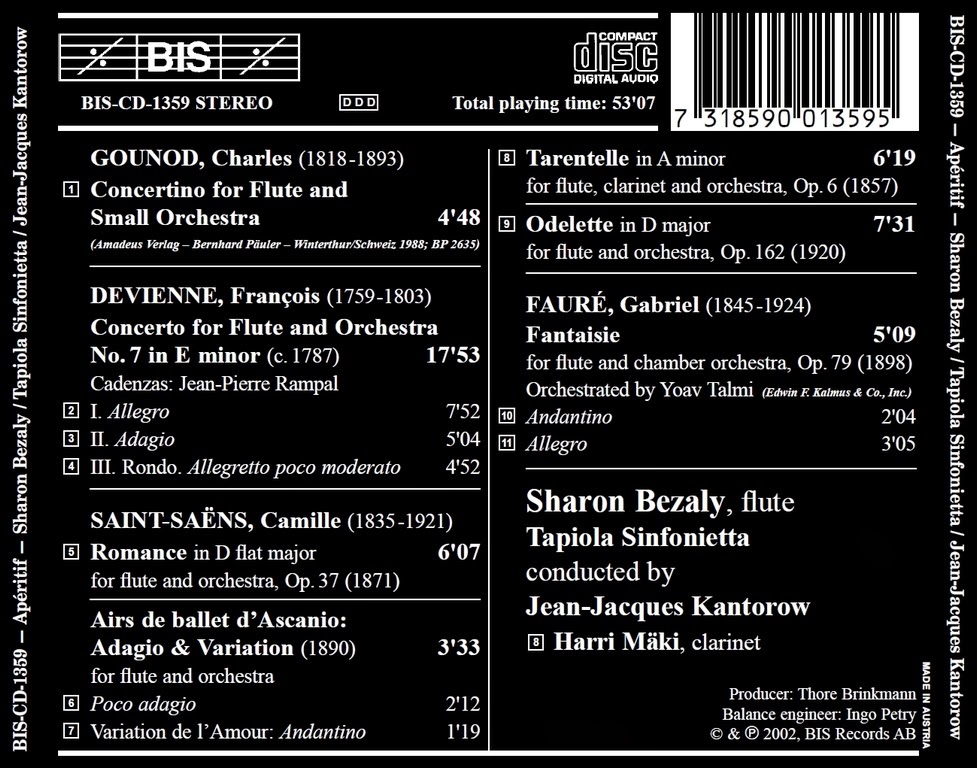
Sharon Bezaly really struts her stuff in this charming, intelligently chosen selection of French gems for flute and orchestra. It goes without saying that Bezaly is up to the challenge that these generally modest pieces (Devienne excepted) present, offering steady, full tone with no trace of irritating breathiness, and more than sufficiently nimble fingers that make short work of, say, Rampal's cadenzas in the Sturm und Drang outer movements of the Devienne E minor Concerto. Anyone who thinks that music for flute and orchestra can't be other than dainty and delectable (or boring) should sample this surprisingly dramatic and substantial concerto, which unflaggingly holds the attention throughout its nearly 18 minutes.


In fact, all of this music is delightful, but in addition to the concerto, two works in particular stand out: Gounod's Concertino, which contains an unforgettable principal theme that wouldn't have been out of place representing the Hobbits in the recent Lord of the Rings films, and Saint-Saëns' late Odelette, seven and a half minutes of pure elegance from a master of instrumental writing. Clarinetist Harri Mäki joins Bezaly quite capably in the same composer's very early (Op. 6) Tarentelle, but otherwise this is Bezaly's show, and she gets first class accompaniments from the Tapiola Sinfonietta under Jean-Jacques Kantorow, all captured in perfectly balanced sound. This is a disc that leaves you wanting more, and given the inherent limitations in range and timbre of Bezaly's instrument, that's saying quite a lot about her masterful handling of it. --David Hurwitz, ClassicsToday.com [2/8/2003]

Sunday, January 26, 2014

“I am charmed by Wispelwey’s playing in the Lalo, I am bowled over by this performance of Saint-Saens asks of him, the multiple-stopping, the passages at the very top of the cello’s range, and so on- Wispelwey’s tone remains centered and mellifluous. Furthermore, he is an intelligent, stylish musician who makes the music interesting.” --International Record Review, September 2013

“[the Lalo] is an underrated piece and the performance given here is extremely fine...Wispelwey is in great form, ably supported by the orchestra and Seikyo Kim...The cello is recorded with clarity and possesses a slight cutting edge...The solo playing is immaculate.” --MusicWeb International, November 2013


After a highly acclaimed recording of Briten’s Cello Symphony (ONYX4058) Pieter Wispelwey and the Flanders Symphony Orchestra, conducted by Seiko Kim, turn to two romantic cello concertos whose neglect is hard to fathom.

Lalo, unusually for a French composer in the mid 19th century, was drawn to chamber music, and formed a string quartet (in which he played viola, and later second violin) that championed the works of Haydn, Mozart and Beethoven. His passion for chamber music developed to embrace large scale orchestral works – two violin concertos, the famous 'Symphonie espagnole' for violin and orchestra, a symphony in G minor, the Piano Concerto and the concerto recorded here: the Cello concerto in D minor of 1877. A strong work in the Germanic tradition, the central movement combines a slow movement and scherzo. Its comparative neglect in the concert hall is difficult to understand as it is an impressive and well made work, worthy of his contemporaries Franck and Saint-Saëns.

The latter’s second cello concerto from 1902 is totally overshadowed by his impressive and dazzling first concerto dating from 1872. The later work has all of the composer’s flair for style, elegance and is possibly more challenging for the soloist than its A minor sibling.
Subscribe to RSS Feed Follow me on Twitter!