Showing posts with label Fauré Gabriel. Show all posts

Friday, November 14, 2014


“turning convention topsy-turvy, she reminds us in her vehement, brightly lit performances that Faure objected to pianists who play his music 'with the shutters down'” --Gramophone Magazine, September 2013

“an exquisite Faure recital...The purity and strong, supple backbone of her playing lets Faure's inventive genius, his extraordinary sensitivity to colour, harmonic shading, texture and eloquence, shine on its own terms...Hewitt can draw us into Faure's unique bubble and simply envelop us in his cool, self-sufficient gorgeousness” --BBC Music Magazine, October 2013 *****


“She brings not just an intimate grasp of the music’s harmonic and technical demands, but an essential refinement – most evident in the Theme and Variations, in which she finds élan, lightness and grandeur without overemphasising the differences between the 11 variations.” --Financial Times, 7th September 2013 ****

“It's a very thoughtfully planned sequence, beautifully executed; the sharply contrasting characters of each of the variations...are perfectly focused, while the joyous exuberance of the early Ballade sweeps all before it...All these pieces are presented with exemplary clarity and wonderfully crystalline tone.” --The Guardian, 5th September 2013 ****

“Particularly masterly are the variations, the heartbreaking 7th and final 12th very lovely. Hewitt observes that Fauré, who did not die until 1924, was born in Schumann and Chopin’s lifetimes: the pianism and songfulness show their legacy.” --The Independent, 15th September 2013 ****

“She plays this repertoire with real vitality and extroversion...Her sense of phrasing and sense of continuity in the three Nocturnes is Collard-like in intimacy and sensitive proportion.” --MusicWeb International, 30th September 2013

Saturday, November 1, 2014


“Played with Tharaud's trademark elegance, and with a keen sense of style, it amounts to a very clever concoction, in which temperature-changes are judiciously controlled and geographical and cultural connections are subtly implied.” --BBC Music Magazine, February 2014 *****

“A special blend of affection and verve, his choice takes us through the familiar and unfamiliar...His way with Chopin's 'Minute' Waltz is scintillating and individual...he captures all of Poulenc's stylised nostalgia...this is a box of delights...Erato's sound is as bright as a button.” --Gramophone Magazine, January 2014


 “Altogether this is a joy. Recorded sound is top-notch, too.” --MusicWeb International, 7th February 2014

“a delightful compilation of lovingly rendered short pieces” --New York Times, 1st January 2014

“Tharaud is an atmospheric, characterful pianist whose individuality seems to communicate best on CD: here he pulls together 23 miniatures into a gorgeous encore collection, at once undemanding yet stimulating...Vivid imagination meets deliciously poised pianism.” --The Observer, 24th November 2013 ****

Sunday, June 15, 2014


“The Dante Quartet are superb advocates, especially in the Franck, where they are without peer among modern accounts.” --BBC Music Magazine, August 2008 *****

“…from the opening bars of the Franck we feel the intensity of the Dante's commitment. In the Fauré there's a nice ebb and flow of feeling as the music progresses… It's certainly playing of great accomplishment.” --Gramophone Magazine, October 2008

BBC Music Magazine Awards 2009 - Chamber Award Winner


The great French composers Fauré and Franck have generally been cast as total opposites, but in fact they had much in common. Neither were really men of the theatre, nor were they natural symphonists, nor were they flashy orchestrators in the Berlioz or Rimsky-Korsakov tradition. But both cultivated what the French call ‘intériorité’, which one could translate as ‘intimacy’, though this loses the sense of deep reflection, even of transcendence, immanent in the French term. Finally, as it turned out, the last works of both were string quartets. Recorded together here, these beautiful final works demonstrate a thorough maturity of spirit and talent in both composers.

Franck’s quartet breaks new ground, particularly in the complex structure of the first movement. The discourse is also shot through with sudden silences, as though questioning the propriety of the whole enterprise—silences whose force was surely not lost on the young Debussy, who a few years later was to claim silence as one of his most fruitful discoveries. The String Quartet in E minor by Fauré is almost backward-looking in its modal tonality, and a model of ‘intériorité’.

Winner of the prestigious Royal Philharmonic Society Award for Chamber Music in 2007, the Dante Quartet is known for its imaginative programming and the emotional intensity of its performances. The group was founded in 1995 at the International Musicians’ Seminar at Prussia Cove, Cornwall. This is its first recording for Hyperion.

Wednesday, January 29, 2014


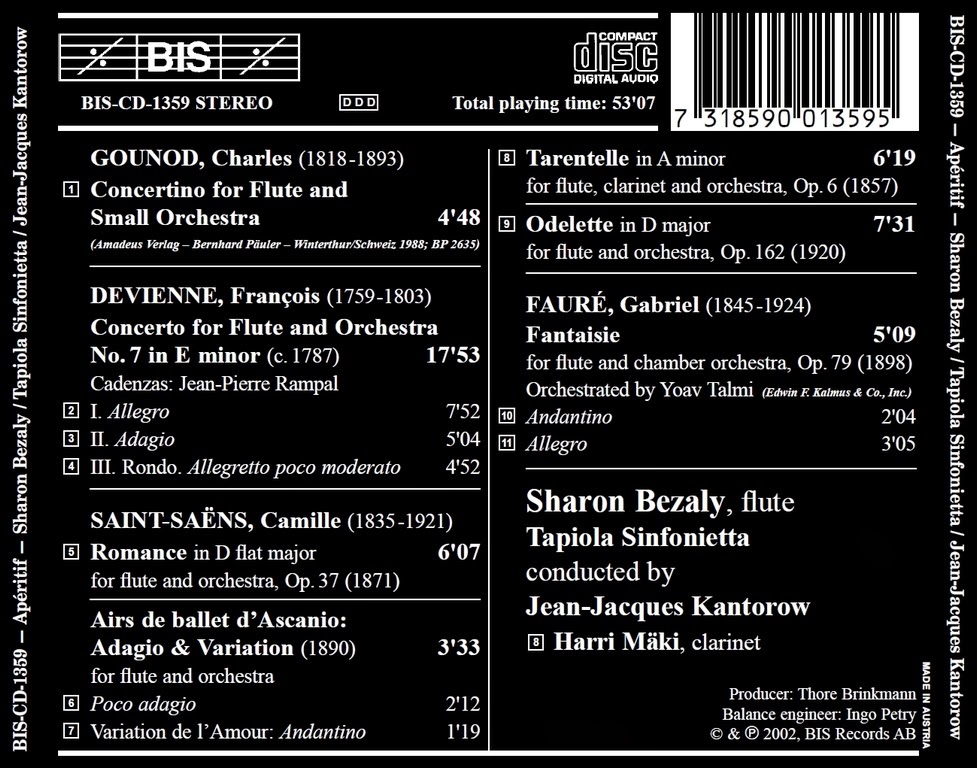
Sharon Bezaly really struts her stuff in this charming, intelligently chosen selection of French gems for flute and orchestra. It goes without saying that Bezaly is up to the challenge that these generally modest pieces (Devienne excepted) present, offering steady, full tone with no trace of irritating breathiness, and more than sufficiently nimble fingers that make short work of, say, Rampal's cadenzas in the Sturm und Drang outer movements of the Devienne E minor Concerto. Anyone who thinks that music for flute and orchestra can't be other than dainty and delectable (or boring) should sample this surprisingly dramatic and substantial concerto, which unflaggingly holds the attention throughout its nearly 18 minutes.


In fact, all of this music is delightful, but in addition to the concerto, two works in particular stand out: Gounod's Concertino, which contains an unforgettable principal theme that wouldn't have been out of place representing the Hobbits in the recent Lord of the Rings films, and Saint-Saëns' late Odelette, seven and a half minutes of pure elegance from a master of instrumental writing. Clarinetist Harri Mäki joins Bezaly quite capably in the same composer's very early (Op. 6) Tarentelle, but otherwise this is Bezaly's show, and she gets first class accompaniments from the Tapiola Sinfonietta under Jean-Jacques Kantorow, all captured in perfectly balanced sound. This is a disc that leaves you wanting more, and given the inherent limitations in range and timbre of Bezaly's instrument, that's saying quite a lot about her masterful handling of it. --David Hurwitz, ClassicsToday.com [2/8/2003]

Tuesday, January 7, 2014

“This blissfully unhackneyed and brilliantly executed recital takes memory in all its facets as its theme...the recording throughout gives the players all the space and atmosphere they need to characterise the varied moods and textures of an unusually rewarding programme.” --Gramophone, Awards Issue 2012

“Match [Ades's playing] with the mellow sound and manner of Steven Isserlis's cello, and you have something very special. Their choice of repertory here - devised as an extended upbeat to Ades's Lieux retrouves at the end of the programme - is unusual, memorable, and wonderfully performed from start to finish.” --BBC Music Magazine, December 2012 *****


A cello recital with a difference from two maverick geniuses, displaying the fecundity of their collaboration. The world-famous cellist Steven Isserlis, one of the best-loved instrumentalists of today, joins forces with composer and pianist Thomas Adès, described by the New York Times as one of the most imposing figures in contemporary music.

This recording opens with three of Liszt’s arrangements for cello and piano—the dark plangency of Isserlis’s tone emphasizing their elegiac power. Janácek’s Pohádka (‘A Tale’) is based on a story with many magical elements, and it is this particular quality which Isserlis and Adès bring out in their aerial performance. The passionate ecstasy of Fauré’s Cello Sonata No 2 is deeply felt, and the elemental mysterious sadness of Kurtág’s miniatures leads the listener into the 21st century and to the ‘title track’ of this disc which Adès wrote for Isserlis himself. Lieux retrouvés is a characteristically thrilling tour de force, displaying influences from all the composers previously featured and many more. The writing for the cello reaches uncharted levels of difficulty. Isserlis in his thoughtful booklet notes describes it in pictorial terms of rivers and mountains—here’s Anthony Tommasini, again in the New York Times: ‘The rippling figures for piano and cello spin out in crazed, cyclic riffs; the crystalline piano harmonies sound as if the wind were rustling the chimes in the pagoda; the feisty, industrialized propulsive bursts in the finale.’
Subscribe to RSS Feed Follow me on Twitter!