Showing posts with label 21th century. Show all posts

Saturday, November 15, 2014


“[The Violin Concerto] is colourful and consistently engaging, filled with ear-catching textures, rhythms and melodies...The orchestra matches Kopatchinskaja's vigour and suppleness with incisive playing.” --BBC Music Magazine, July 2010 ****

Fazil Say is an accomplished and acclaimed pianist, but the main focus here is on his composing talents. Not so long ago there was a craze for late-18th and 19th-century music that mingled European styles with Turkish traditions. Say demonstrates that this kind of fusion remains fertile in the 21st-century.


His Violin Concerto, written for Patricia Kopatchinskaja who performs here, is colourful and constantly engaging, filled with ear-catching textures, rhythms and melodies. As with Sheherazade, the violin unspools fascinating tales, linking the movements with cadenzas which, as Say says, bind them into an ‘intensely atmospheric unity’. The orchestra match Kopatchinskaja’s vigour and suppleness with incisive playing.

The sleeve, booklet and label go astray on the track order from here. On the disc, Summertimes, a set of cool jazz-flavoured solo piano variations on the Gershwin classic, follows the Concerto. Say displays his technique as well as his understanding of piano-jazz history.

Similarly, on his 110-second alla Turca Fantasia, he mingles Mozart with stride and boogie, but it hardly stands up against Brubeck’s masterpiece Blue Rondo à la Turk! The lovely, evocative and lyrical Patara, also Mozart-inspired, is here performed by piano, soprano, ney (Persian flute) and percussion, forming a magical core for the programme. --Barry Witherden, BBC Music Magazine


Saturday, November 1, 2014


Though Holst learned of the discovery of Pluto four years before he died, it probably did not occur to him to add another movement, especially since the work's last section, "Neptune, the Mystic," ends in an other-worldly, ethereal fade-out, enhanced by an off-stage wordless women's chorus. He would have been surprised by the latest development in Pluto's status, but undoubtedly pleased that his ultimately incomplete Suite-- which had become more popular than he had expected or thought it deserved--had inspired another British composer, Colin Matthews, to write a successful companion piece, "Pluto, the Renewer," in 2000. Moreover, the Berlin Philharmonic added to Holst's galaxy by commissioning four composers to write a movement each for a Suite called "Asteroids." 


This is its premiere recording.

The idea of "music of the spheres" goes back to antiquity; perhaps the most famous example of its influence is the slow movement of Beethoven's second "Rasumovsky" String Quartet. Holst gives each of his planets its mythological characteristics: "Mars" is forcefully war-like, "Venus" melodiously peaceful; "Mercury" is a fleet, skittish Scherzo, "Jupiter" rambunctious but suddenly songful. "Saturn" is a soft, solemn march, and "Uranus" murmurs and glitters. The work's most striking element is the scoring. A huge orchestra produces enormous contrasts (underlined by the recording), incredibly colorful sound effects and lush, dense, sonorities, with a lot of melodic doubling and undulating accompanying figures. The sound-world of the "Asteroids" is also based on instrumental colors and effects: whispers, shimmers, crashes and extreme registers. All this is just right for this virtuoso orchestra. --Edith Eisler

Thursday, October 16, 2014


"The KU Wind Ensemble has appeared on several other Naxos CDs. It is undoubtedly one of the top such ensembles in the United States, and the talent on display here is of professional quality. Conductor Paul W. Popiel leads crisp, precise, and idiomatic performances, drawing the best out of his young players. Thank goodness for conductors such as Popiel, who keep the wind ensemble repertoire growing, and who encourage innovation. In the Glass, soloist Ji Hye Jung…and Gwendolyn Burgett…are no less impressive." --Fanfare, May 2014


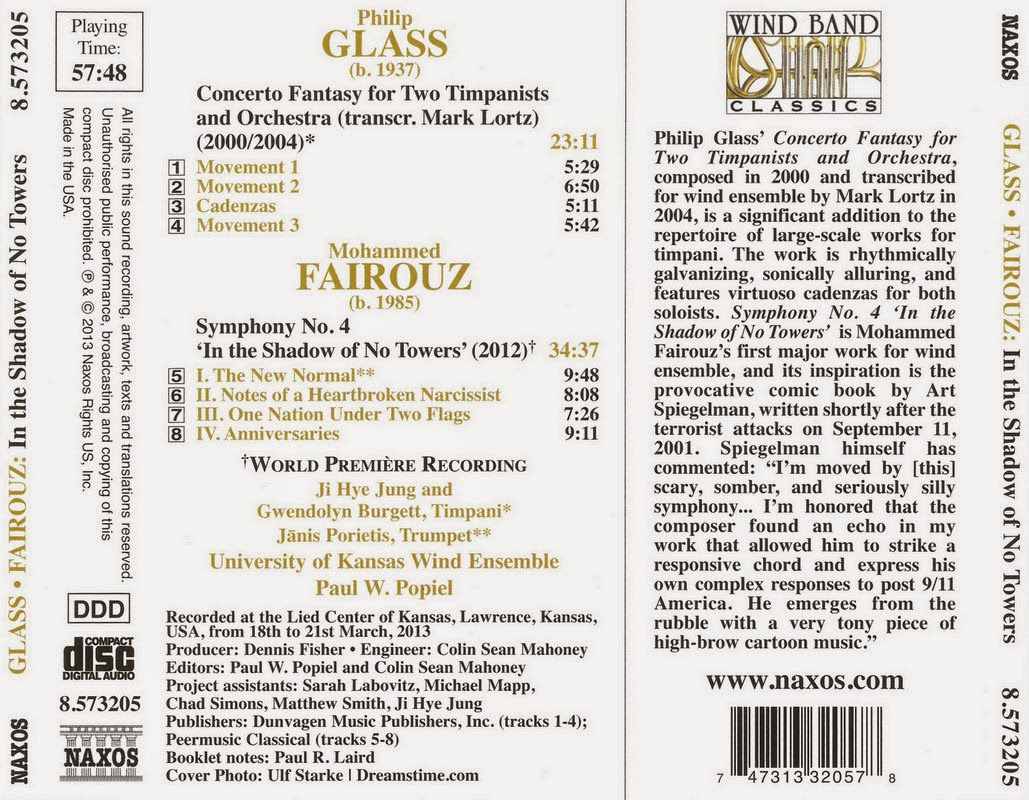
Philip Glass’ Concerto Fantasy for Two Timpanists and Orchestra, composed in 2000 and transcribed for wind ensemble by Mark Lortz in 2004, is a significant addition to the repertoire of large-scale works for timpani. The work is rhythmically galvanizing, sonically alluring, and features virtuoso cadenzas for both soloists. Symphony No 4 ‘In the Shadow of No Towers’ is Mohammed Fairouz’s first major work for wind ensemble, and its inspiration is the provocative comic book by Art Spiegelman, written shortly after the terrorist attacks on September 11, 2001. Spiegelman himself has commented: “I’m moved by [this] scary, somber, and seriously silly symphony…I’m honored that the composer found an echo in my work that allowed him to strike a responsive chord and express his own complex responses to post 9/11 America. He emerges from the rubble with a very tony piece of high-brow cartoon music.

Saturday, October 11, 2014


“Beside this, other recent violin concertos shrivel: this is a work that sings and soars with a visionary beauty rare in contemporary music. Against a vague, swirling background, the violinist enters on open strings. She’s tuning up for an incredible journey through Chin’s light, fantastic world, shaped as much by Far Eastern music cultures as the structures of Western tradition.” The Times, 31st July 2009 ****

Gramophone Awards 2010 Finalist - Contemporary


Kent Nagano and the OSM explore Korean composer Unsuk Chin's artistic landscape. Chin's music is modern in language, but lyrical in communicative power. The colour of her music might be explained by Chin's affinity for non-European music and by her occupation with electronic music. This recording principal work, the prestigious Grawemeyer award-winning Violin Concerto, Viviane Hagner shows an almost hauntingly masterful display of technique and artistry. Also on this recording, the iridescent Rocaná, an orchestral work commissioned by Maestro Kent Nagano.

Friday, September 26, 2014


"Chin's "Piano Concerto" opens with sparkling showers of piano, flute and high strings, developing a gently implacable tread of piano as orchestral colours grow more intense . . . it's the "Su for Sheng and Orchestra" that stands out: a bamboo mouth-organ capable, under virtuoso Wu Wei, of sounds evanescent and emotive, the sheng resembles organ, synthesizer and accordion in a flowing dialogue with strings and percussion, dictating the orchestral response." --Independent, 09. August 2014

“The music is nothing if not hyperactive, brilliantly orchestrated and atmospheric too. Try it; you may be pleasantly surprised.” The Times, 23. August 2014 ***


"The Cello Concerto . . . is the biggest and most ambitious of the three, and arguably the most important concerto for that instrument to appear since Lutoslawski's in 1970. The solo writing pushes the cellist -- the superb Alban Gerhardt -- to the limits of the possible . . . [Piano Concerto]: as the soloist Sunwook Kim shows, the total effect is undeniably brilliant and effective . . . ["Su" for sheng and orchestra]: [it's Wu Wei's] extraordinary virtuosity that allows [Unsuk Chin] to create such original textures, with the sheng adding a reedy edge to the slowly shifting chords, or a shimmering haze to the more swiftly moving passages. The effects are beautifully judged and, as in all the works here, meticulously realised by the Seoul Philharmonic under Myung-Whun Chung." --The Guardian, 13. August 2014

Saturday, May 17, 2014


Fazil Say is a polyvalent artist (classical and jazz pianist, compositor); he dedicates more and more time and energy to composition: after his disk Istanbul Symphony, he pays a tribute to his culture and middle-East with the symphonies Mesopotamia and Universe. These two pieces both include eastern symphonic orchestra and instruments (theremin, flutes, percussions)...

“In these colourful, eclectic, dramatic works...Say impressively flexes his compositional muscles and pianistic dexterity.” --BBC Music Magazine, February 2014 ****


In constructing the Mesopotamia Symphony, Fazil Say attempts to narrate the story of the present day Middle East as well as the culture of Mesopotamia throughout history. It is a land which cradles within it the history of the Sumerians, the culture and beliefs of Assyria, Babylon and Urartu. From there we move to our own day and the contemporary issues facing the Middle East and Turkey; the Kurdish problem, the never-ending wars, terror. In the words of the philosophers, this is a “culture of death.” The region known as Mesopotamia is known as the cradle of culture and humanity; so many things which define us as human being emerged here thousands of years ago.There is a particular “Opera of Instruments” technique prevalent in Say’s symphony. The composer narrates the symphony through two solo instruments, the bass flute and the bass recorder, which represent two children, or more specifically two brothers. These two instruments symbolically and simply represent the “innocent human being.” Tragically, one of the brothers will be shot. The Theremin on the other hand is the symbolic “Angel,” the protector of Mesopotamia in its harrowing drama. For the composer, the Mesopotamia Symphony signifies a call to peace.

The Universe symphony is created from astronomic as opposed to astrologic data. Astronomic data is of course directly dependent on changes in current science and in this work, the composer is using scientific data available in 2012. In this sense, the Big Bang, the expansion of the universe, the contention that Gliese 581 g may be an earth-like planet, the supposition that the God Particle may be found after analysis of dark matter – all of this may be deemed to contain no truth by the future world of science.

Meanings of the harmonic construction
1- Nature: Major tonality
2- Humans: Minor tonality
3- Chaos: Atonality
4- Frequency of the void of the universe: D Note

Friday, March 7, 2014


“Ge Gan-ru incorporates elements of traditional music and richly-scored late-Romanticism. Bezaly admirably meets the extraordinary demands of Meng Jiang.” --BBC Music Magazine, February 2014 ****

“For all of the gently artistry on show in the four-movement work that is Fairy Lady Meng Jiang the music is predominantly a vortex of the distraught and the anxious...This will broaden your horizons and introduce you to Ge, a composer...who is at ease working with the avant-garde and with the sentimentally eloquent.” --MusicWeb International, February 2014


Born in Shanghai in 1954, Ge Gan-ru grew up at a time when Western music was not heard in public, and could only be studied in secret. As the political and cultural atmosphere in China changed, Ge became one of the first students to enrol at the re-opened Shanghai Conservatory. There he was able to acquaint himself with the music of composers such as John Cage, George Crumb and Pierre Boulez, and it was at this time that he earned the designation ‘China’s first avant-garde composer’. Moving to New York in 1983, he continued his studies, with the expressed aim ‘to combine contemporary Western compositional techniques with my Chinese experience and Chinese musical characteristics’. A previous recording on BIS of Ge Gan-ru’s orchestral music impressed reviewers, with the website ClassicsToday.com remarking on the composer’s ‘immediately identifiable, intriguingly personal style’, ‘alternately exciting and ravishing’ and ‘full of warmth and humour’.

The present disc combines two works which both proudly display their Chinese roots. The flute concerto Fairy Lady Meng Jiang is inspired by a classic Chinese fairy-tale, set in the 3rd century B.C. at the time of the building of the Great Wall and incorporating an element of magic as well as a dramatic love story with a deeply unhappy ending. The work is dedicated to Sharon Bezaly, the soloist on this recording, who also gave it its first performance together with the Orquesta Sinfónica de Castilla y León and Enrique Diemecke in March 2009. The same occasion saw the first performance of its companion piece, the orchestral suite Lovers Besieged which the composer developed from an earlier trio for cello, percussion and piano. Again the work is rooted in early Chinese history – in fact just a few years after the events befalling Meng Jiang – and again it is a story of love and death, now played out against a back-drop of war and insurrection during the collapse of the Qin dynasty.

Tuesday, March 4, 2014


"Banks has a genuine melodic gift... The LPO under Mike Dixon play sympathetically and often ardently, and the woodwind relish Simon Hale­Ýs many piquant touches of colour." --Gramophone, May 2004

"Fans of Tony Banks will be queuing to buy the album and it has 'chill out' possibilities for the post-party coterie." --MusicWeb International


"There's absolutely no reason why pop music writers should not attempt to compose large-scale orchestral works, and I applaud Tony Banks for making the effort...The performance as such sounds perfectly fine and is very well recorded; the London Philharmonic does a thoroughly creditable job under Mike Dixon. I don't think Naxos was wrong to go for this project; Banks has a following and his fans may enjoy it."--ClassicsToday.com

Wednesday, February 26, 2014


“a superb coupling of two strongly communicative contemporary works…which demonstrate Aho’s comprehensive mastery of rhythm, timbre and drama. Again, the performance is a definitive one and BIS's engineering breathtaking in its realism.” --Gramophone, July 2004

Gramophone Magazine
Editor's Choice - July 2004


“Aho's Symphonic Dances (2001) bear the subtitle 'Hommage à Uuno Klami' – and therein lies the clue to the work's genesis. Klami (1900- 1961), one of the leading Finnish composers of the last century, had high hopes for his largescale, Kalevala-inspired ballet Pyrörteitä, but by the time of his death had managed to orchestrate only the second of its three acts. Aho orchestrated Act 1 in 1988. During 2000, no material having come to light for the final act, he embarked on completing Klami's magnumopus, bolstered by the prospect of a production at the Finnish National Ballet. In the event, that belated premiere never materialised, and it was left to Osmo Vänskä and the Lahti SO to champion Aho's 'Third Act' in the concert hall. A thoroughly approachable, 27-minute creation of exhilarating drive and colour, its four movements take their names from Klami's original synopsis. It's stunningly well served here by artists and production crew alike.

Symphony No 11 is almost as rewarding. It grew out of a commission for an orchestral work involving the Kroumata Percussion Ensemble, and is cast in three movements, the last of which distils a wondrous stillness and inner calm. It also serves as a perfect foil to the first two movements, both of which demonstrate Aho's comprehensive mastery of rhythm, timbre and drama. Again, the performance is a definitive one and BIS's engineering breathtaking in its realism.” --Gramophone Classical Music Guide, 2010

Friday, February 14, 2014


"Two splendidly enjoyable modern concertos superbly performed and in the finest sound... Another magnificent recording from BIS and the Lahti orchestra, this time of very recent music." --MusicWeb International, October 2013
 
“Kuusisto's own Concerto (2011) is a colourful and dramatic score...The finale's rhythmic drive and alternating lyricism are immensely appealing...Excellent performances and sound.” --Gramophone Magazine, October 2013


John Corigliano's violin concerto 'The Red Violin' originated as the score to a film about a violin by one of the Old Italian master-builders, and its journeys around the world throughout three centuries. While working on the film score, Corigliano also produced a one-movement concert version of it, which he later expanded into a full-scale concerto in four movements. The son of a violinist, Corigliano’s aim was to write a concerto in a style his father would have wanted to play, and he has managed to do so without sacrificing any of the music's communicative qualities, or its wealth of colours, emotions and atmospheres.

The work is coupled here with a concerto of a similar broad appeal, composed by Jaakko Kuusisto, who is a highly respected violinist in his own right, as well as conductor. In his liner notes, Kuusisto recounts how he had toyed with the idea of writing a violin concerto for several years, but that the project only came into fruition after a commission from his colleague Elina Vähälä, and the liberating prospect of composing a work for another performer than himself. Appearing for the first time on BIS, the acclaimed violinist Elina Vähäla has a wide-ranging career, both geographically and in terms of repertoire. She made her début at the age of twelve, performing as a soloist with the Lahti Symphony Orchestra, which lends her spirited support on the present disc, and also performs the orchestral piece Leika. Using the Icelandic word for ‘play’ as its title, Kuusisto’s composition displays a playfulness and wealth of colours that makes it a perfect curtain raiser for this appealing disc.

Wednesday, February 12, 2014


“In Christian Tetzlaff, Daniel Harding and the Swedish RSO, Widmann has found suitably uncompromising interpreters, and the recordings are as unvarnished and wide in perspective as the music itself demands.” --Gramophone Magazine, August 2013

“Widmann's Violin Concerto will appeal to those who like Berg's. Tetzlaff's performance is outstanding...An impressive collection.” --BBC Music Magazine, December 2013 ****


“[Tetzlaff's account is] so astonishingly vivid and secure that Widmann's impressive work at least has to share the spotlight with its dedicatee...Tetzlaff makes every second matter; one is carried along on the bleak journey Widmann invents” --The Guardian, 23rd May 2013 ****

Saturday, February 8, 2014

“Ex-Genesis member Tony Banks in classical mode, each of the six pieces majoring on rhapsodic feeling and bold melodies. Blade, featuring the solo violin of Charlie Siem, is the most impressive.” --BBC Music Magazine, June 2012 ****

“These six symphonic songs are full of openhearted melody and glamorous orchestration…Particularly pleasing is The Oracle, a serene bit of tunefulness that has harmonies, harps, and woodwind writing that sound a bit like early Delius. The orchestra has a big, brassy sound, with lush strings for the soupier lyrical moments—and there are plenty of those. Martin Robertson’s alto sax solos in Siren and Charlie Siem’s violin in Blade are smooth and stylish.” --American Record Guide, September 2012


Tony Banks, founder member of rock band Genesis, has already written a much admired orchestral work called Seven (8557466), in which he was praised for his ‘genuine melodic gift’ (Gramophone). His new work consists of six evocative songs without words which may arouse in the listener ideas of seduction, journeys, heroes, quests, decisions and goals. Two of the pieces feature solo instruments – alto saxophone on Siren and violin on Blade – played here by elite soloists, which mesh into Banks’s orchestral tapestry with bewitching effect. The remaining pieces reveal his outstanding lyrical gifts and total command of musical narrative.

Tony Banks has a big following for his solo work outside the group. His classical compositions have been admired for their lyricism and melodic qualities, with some critics noting an affinity with the string works of Vaughan Williams.
Subscribe to RSS Feed Follow me on Twitter!